In more ways than one, really. I am not talking about bran muffins, I am talking about fiber optic cable in this case, although if you are eating something with whole grains right now, more power to you! Anyway, the library system where I worked prior to the wonderful Hutchinson Public Library was part of a county government. To their credit, they realized that as their county grew and data demand soared they needed a solution that would get them ahead of the curve. So about 5 years ago in 2004-5, they started building their own 100Mb (megabit) fiber network. For comparison, the average home connection speed in Kansas in 2009 was 4.9Mb, not quite 1/20th of what they built. So this was a pretty progressive and aggressive plan at the time. In fact, when I left that library system the slowest connection in the county system was the 10Mb pipe to the Internet.
Why am I carrying on about data and pipes and megabits? Because of this article. The National Broadband Plan could wire "anchor institutions" such as schools, community centers, colleges and libraries such as good ol' HPL, with 1Gb fiber connections. A gigabit represents 1 billion bits or 1,000 megabits. In other words, this FCC proposal would create connection points in communities 10 times faster than the network my old employers built. The implications are enormous. A plan of this type could leapfrog the US back into the top tier of nations in the area of Internet connection speed. Since we currently rank 28th in the world, I think this plan is worth attempting on the basis of lowering our international "Embarrassment-to-Prestige Ratio" alone.
More importantly, it could create the possibility in virtually every rural town for solid, high-speed Internet access. This quote, from the ArsTechnica article above sums it up for me: Bob Bocher, who works as a consultant with the Wisconsin State Library, says, "The more than 16,000 public libraries across the country are often the only places in their communities that offer no-fee Internet access to all residents.
This is certainly the case, for better or worse, at HPL. As our bandwidth needs have grown, an ever-larger chunk of our limited funds have gone toward maintaining a tolerable usability level connecting to the Internet and the library's many paid digital services. So I am excited about this change. I wonder if the funding will be found to make it a reality?
Tuesday, March 23, 2010


Thursday, March 11, 2010
The HPL 2010 Project and Ebooks
Typically around this time of year, HPL sponsors a huge number of programs. This surge in program offerings seems to come from two directions; our own surge in energy following the sometimes-exhausting holiday season, and an urge to try some new ideas.
The HPL 2010 Project is one of those new ideas. We are now past the mid-point in this experiment in self-paced technology training. Hundreds of patrons and dozens of HPL staff members have learned about RSS feeds, streaming music, online TV, online newspapers and book reviews, cool library tools, with much more to come.
The responses to this project have been so overwhelmingly positive that I think we will adapt the concept of The 2010 Project for future uses and maybe offer it as an ongoing self-paced teaching tool.
And now a word about ebooks (because I can't help myself). We receive a variety of questions about ebooks here at HPL. Most of them revolve around the basic, 'Do you have any?" the answer to that is, at this point, "precious few". We have access to more through the State Library's download site, but as is the case with all new formats, it takes awhile to build what one might consider a 'good" collection. That's not a cop-out, it is simply a function of having the money to do it or not. One of our considerations is what will become the "standard" so that we don't buy a bunch of titles that are incompatible with the majority of readers. I read lots about this, having set up a Google news custom section for this topic. Recently a great article came up that I would like to recommend. It sums up the current state format standards (or lack thereof) much better than I could do it.
OK, that's enough rambling. Back to worrying about roof leaks and budgets...sigh.
The HPL 2010 Project is one of those new ideas. We are now past the mid-point in this experiment in self-paced technology training. Hundreds of patrons and dozens of HPL staff members have learned about RSS feeds, streaming music, online TV, online newspapers and book reviews, cool library tools, with much more to come.
The responses to this project have been so overwhelmingly positive that I think we will adapt the concept of The 2010 Project for future uses and maybe offer it as an ongoing self-paced teaching tool.
And now a word about ebooks (because I can't help myself). We receive a variety of questions about ebooks here at HPL. Most of them revolve around the basic, 'Do you have any?" the answer to that is, at this point, "precious few". We have access to more through the State Library's download site, but as is the case with all new formats, it takes awhile to build what one might consider a 'good" collection. That's not a cop-out, it is simply a function of having the money to do it or not. One of our considerations is what will become the "standard" so that we don't buy a bunch of titles that are incompatible with the majority of readers. I read lots about this, having set up a Google news custom section for this topic. Recently a great article came up that I would like to recommend. It sums up the current state format standards (or lack thereof) much better than I could do it.
OK, that's enough rambling. Back to worrying about roof leaks and budgets...sigh.
Thursday, February 25, 2010
Books, books, books
Sometimes as we (and by "we", I mean "I") march along, toiling away to keep up with changes in technology, tastes, economies, and on and on, we overlook the fact that as librarians our basic stock-in-trade is still the humble paper book. Will the "book" die? Should we add more of format "X" instead of format "Y"? These are a couple of things I think about a lot. The former question is answered, I think, by this great article by author John Green. I guess I should say that it doesn't directly answer whether or not the "book" will die, rather it suggests that maybe we shouldn't sweat that so much as whether reading will die. This is the fundamental issue. From a librarian's perspective, we want people to read, we want people to find what they like / need / want to fulfill their knowledge "quest", whatever that may be.
Librarians are closely associated with the place called "the library". I know...durrrr. It is a place filled with stuff, currently the stuff is mostly books. On the surface, there's nothing remarkable about that except for the scale and the organization of it. But underneath is the thing that truly matters about a library collection. That is the fact that the "things" in it were chosen for a reason. They were chosen by a skilled professional selector. The items in a library collection are in general chosen to fill a need AND because that particular item was the best available at the time. I do not know of any librarian worth their salt who wouldn't strive to find the "best" whatever to fill the gap in their collection. That, to me, is where the true power lies for librarians. It doesn't really matter whether it is format "X" or "Y", the value of the item to whatever body of knowledge it might belong trumps format.
I guess I am trying to say that while more formats might appear, it does not really matter. The savvy librarian who can advertise the fact that he or she has collected the best of what is available, will preserve the place of the library and the librarian as a trusted authority in its community.
Librarians are closely associated with the place called "the library". I know...durrrr. It is a place filled with stuff, currently the stuff is mostly books. On the surface, there's nothing remarkable about that except for the scale and the organization of it. But underneath is the thing that truly matters about a library collection. That is the fact that the "things" in it were chosen for a reason. They were chosen by a skilled professional selector. The items in a library collection are in general chosen to fill a need AND because that particular item was the best available at the time. I do not know of any librarian worth their salt who wouldn't strive to find the "best" whatever to fill the gap in their collection. That, to me, is where the true power lies for librarians. It doesn't really matter whether it is format "X" or "Y", the value of the item to whatever body of knowledge it might belong trumps format.
I guess I am trying to say that while more formats might appear, it does not really matter. The savvy librarian who can advertise the fact that he or she has collected the best of what is available, will preserve the place of the library and the librarian as a trusted authority in its community.
Wednesday, February 17, 2010
Question Time
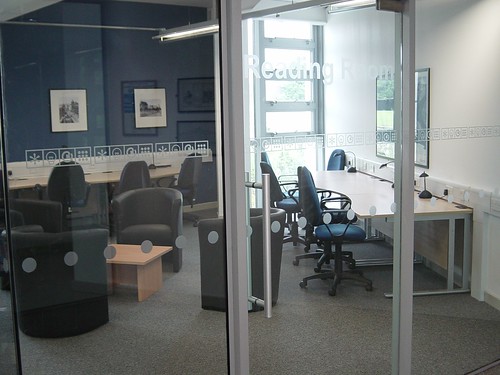
Not for me, for you. We are preparing our move toward a "quiet reading room" and I would like to gather input from the general public regarding features desired for inside the space, what the surrounding area should be like, and also what should happen in nearby areas such as those occupied by the magazines and newspapers area and the YAs (young adults). In order to gather the information, I invite comments here on this blog but I have also created a short survey here and on our website. Here are some samples:
In this first one, please note that we will not have a glass-walled box. I was looking more at the furniture.
Again, looking at the furniture - large chairs, study tables, etc.
A much more traditional look in this picture, and closer to the amount of space we have available.
A modern look with a long computer-friendly table on one wall.
We might be able to "fake" a fireplace as in this photo.
The overall idea is to have a place where there is guaranteed peace in which to concentrate and at the same time be comfortable and inviting. Our room is not gigantic, but it is a good size. The area outside the room is large but broken up by several columns and by virtue of being near both the YA and magazine areas tending toward the possibility of noise. Most of the time, however, this area too is fairly quiet. Part of the decor for the quiet room will be woodwork from the Women's Civic Center. It is dark, stately, beautiful paneling that I think will lend some gravity to the space. Other than that, I think any thing that will fit is fair game as are any ideas for the area surrounding the room. Please lend your opinion, I'd like to hear your ideas!
In this first one, please note that we will not have a glass-walled box. I was looking more at the furniture.
Again, looking at the furniture - large chairs, study tables, etc.

A much more traditional look in this picture, and closer to the amount of space we have available.

A modern look with a long computer-friendly table on one wall.
We might be able to "fake" a fireplace as in this photo.

The overall idea is to have a place where there is guaranteed peace in which to concentrate and at the same time be comfortable and inviting. Our room is not gigantic, but it is a good size. The area outside the room is large but broken up by several columns and by virtue of being near both the YA and magazine areas tending toward the possibility of noise. Most of the time, however, this area too is fairly quiet. Part of the decor for the quiet room will be woodwork from the Women's Civic Center. It is dark, stately, beautiful paneling that I think will lend some gravity to the space. Other than that, I think any thing that will fit is fair game as are any ideas for the area surrounding the room. Please lend your opinion, I'd like to hear your ideas!
Friday, February 12, 2010
Computing in the Cloud
Sounds peaceful, even idyllic doesn't it? For the most part it actually is. In fact, I think this whole notion of cloud computing (EDIT: this article is a great overview) is the most important increase in Internet usefulness since, well, ever I guess. I say that because, all the social and interactive tools of the Web 2.0 idea aside, this shift is fundamental. It moves us away from being tied to a location, i.e. your personal computer / desk / network hardware / building to access your favorite tools. As long as you have signal, you have access to your stuff on your smart phone, net- or notebook. Of course, the devil is in the details.
I read this article today regarding the need for privacy and security laws in the realm of cloud computing. Now, the skeptic in me wonders why Microsoft would be bringing up privacy concerns and security concerns. Maybe to take the high ground after the whole Google vs. China situation (read about that here and here). No matter the reason, Microsoft is right. From my position as a person "in charge" of literally tens of thousands of patron records, data security is pretty high on the list of things to have covered. Now, we are not anywhere near the stage where HPL could provide an integrated library system in a cloud environment even if we hadn't just purchased a new system and hardware to match.
As an individual, I like the cloud concept and am increasingly becoming beholden to Google. At this point, using Google Docs / Reader / Calendar / GMail / Chat / Sites / Analytics / etc., I really don't need anything else for work besides access to the library's automation system. But I also don't really believe that Google can or will live up to its "Do No Evil" slogan if left to its own devices. And not to pick on Google, they are just the most familiar target for me in this area.
Here at HPL, we have been using various free Google tools in place of internally maintained pieces of software and hardware for various experimental programs. We are using a lot of shared calendars, for example, in order to keep track of each other and all the events that go on around here. We are also using Google Docs and forms for our Purchase vs. Borrow program for materials. But for now, experiments are probably all we will do until the "cloudscape" becomes becomes a little less nebulous.
I read this article today regarding the need for privacy and security laws in the realm of cloud computing. Now, the skeptic in me wonders why Microsoft would be bringing up privacy concerns and security concerns. Maybe to take the high ground after the whole Google vs. China situation (read about that here and here). No matter the reason, Microsoft is right. From my position as a person "in charge" of literally tens of thousands of patron records, data security is pretty high on the list of things to have covered. Now, we are not anywhere near the stage where HPL could provide an integrated library system in a cloud environment even if we hadn't just purchased a new system and hardware to match.
As an individual, I like the cloud concept and am increasingly becoming beholden to Google. At this point, using Google Docs / Reader / Calendar / GMail / Chat / Sites / Analytics / etc., I really don't need anything else for work besides access to the library's automation system. But I also don't really believe that Google can or will live up to its "Do No Evil" slogan if left to its own devices. And not to pick on Google, they are just the most familiar target for me in this area.
Here at HPL, we have been using various free Google tools in place of internally maintained pieces of software and hardware for various experimental programs. We are using a lot of shared calendars, for example, in order to keep track of each other and all the events that go on around here. We are also using Google Docs and forms for our Purchase vs. Borrow program for materials. But for now, experiments are probably all we will do until the "cloudscape" becomes becomes a little less nebulous.
Thursday, February 11, 2010
300+ people signed up for the 2010 Project!
Continuing my love affair with the exclamation point, I am going to repeat the title: 300+ people signed up for the 2010 Project! The last tally I heard just after the start of the project was 267 patrons and 40 staff members. Now, this is not a knock against Kristine, our great technology trainer and designer of the 2010 Project, but when she proposed a target of 250 participants I was skeptical. Happy that she set the bar high, but skeptical nonetheless because I am by nature something of a glass-half-empty type.
Anyway, the project is in full-swing. Kristine blew past her sign up goal. Now, all we have to do is enjoy the learning challenges presented each week and take notes on the feedback so we can improve for the next time. Really, I could not be happier. I think it is great that the library can provide a program that so many people found interesting enough to at least sign up and see what it is all about. I hope a large percentage complete the 2010 Project and feel like they can share their observations about it. This is something that, especially with the start-up work done, we can modify and use again and again if we want and if the patrons want.
Here's a link to a .pdf describing another program going on here this spring. We have done a number of these themed, expert-led book discussion series provided through the Kansas Humanities Council. Time is rather short for the first book, and I think all our copies are checked out. But there is plenty of time to sign up for any of the rest of the series and get the book read.
Anyway, the project is in full-swing. Kristine blew past her sign up goal. Now, all we have to do is enjoy the learning challenges presented each week and take notes on the feedback so we can improve for the next time. Really, I could not be happier. I think it is great that the library can provide a program that so many people found interesting enough to at least sign up and see what it is all about. I hope a large percentage complete the 2010 Project and feel like they can share their observations about it. This is something that, especially with the start-up work done, we can modify and use again and again if we want and if the patrons want.
Here's a link to a .pdf describing another program going on here this spring. We have done a number of these themed, expert-led book discussion series provided through the Kansas Humanities Council. Time is rather short for the first book, and I think all our copies are checked out. But there is plenty of time to sign up for any of the rest of the series and get the book read.
Wednesday, February 3, 2010
Statistical Round-Up
Another year has come and gone, 2009 has come to a close. I know, you are thinking I must have been in a coma or something because a month of 2010 has already passed. This time of year though is the time for Kansas libraries to look back over their recently completed year and do one of a number of things. Well, two things at a minimum really. We are compelled to complete an annual report for the state if we want to remain an accredited public library. The second thing we do is look over that past year for areas to improve and for trumpet-worthy accomplishments.
I have spent a bit of time each day for the past couple of weeks working on both HPL's report to the state and looking at what improved last year. One thing is for certain, the budget did not improve. But the ever-resourceful HPL staff found many ways to stretch our dollars and provide quality services. For example, we served 33.3% more children through our various programs than in 2008. That represents over 3,000 more opportunities to show children what the library has to offer them than in 2008 - incredible! Our materials circulation was up this year too. For the first time in my tenure we broke the 400,000 item barrier. That means that in 2009 slightly over 1,200 items per day every day were either checked out or re-checked. I think that is remarkable! I am going to attribute part of that last figure to Wowbrary. This free service sends you a weekly email detailing all of the new things we have added to the collection in the past week. Thank you to our Friends of the Library group for that subscription!
So, I get to compile all these numbers and the management team gets to hear me grouse about creating "yet another bureaucratic pile of non-sense" but once it is done, reflection can be quite illuminating. By doing this sort of task, I am reminded that I have a truly wonderful, extremely hard working group of people here at the library and for that I am indeed thankful - and you should be too!
Subscribe to:
Posts (Atom)